
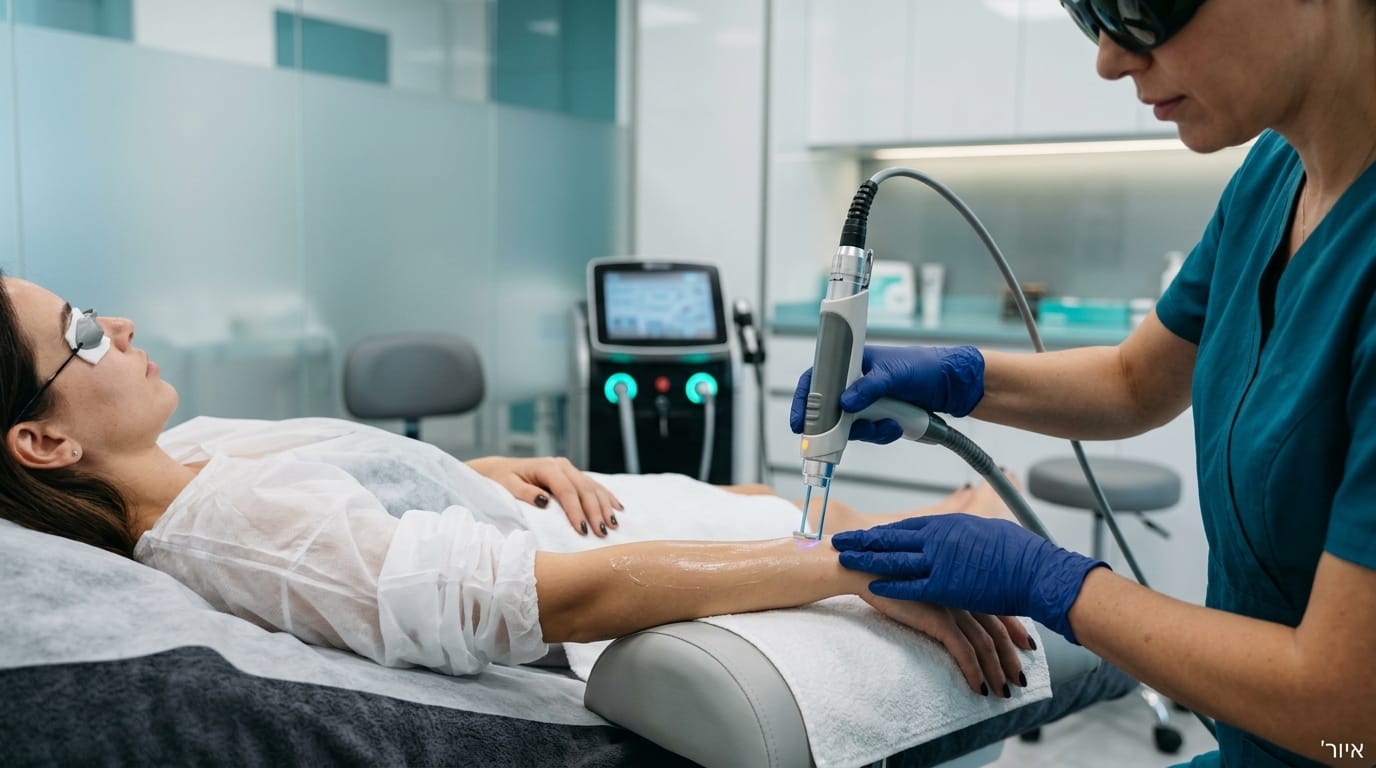
Laser hair removal has undergone a quiet revolution. Instead of a laser with a single wavelength, the advanced generation combines two wavelengths in one system — what is known as combined or hybrid technology (Mixed Technology). This approach significantly expands the range of skin types and hair types that can be treated safely.
For a clinic, the difference is not semantic. True mixed technology determines which patients you can accept, how many treatments will be required, and how safe the treatment is on dark or tanned skin. Just as important: not everything marketed as “mixed” actually works the same way.
In brief
- Mixed technology combines two wavelengths — Alexandrite (755nm) and Nd:YAG (1064nm) — in a single laser system, emitted simultaneously or sequentially through a single delivery.
- The combination targets melanin, water (the skin’s moisture) and hemoglobin and deoxyhemoglobin simultaneously, making it possible to treat all skin types, including Fitzpatrick VI and tanned skin.
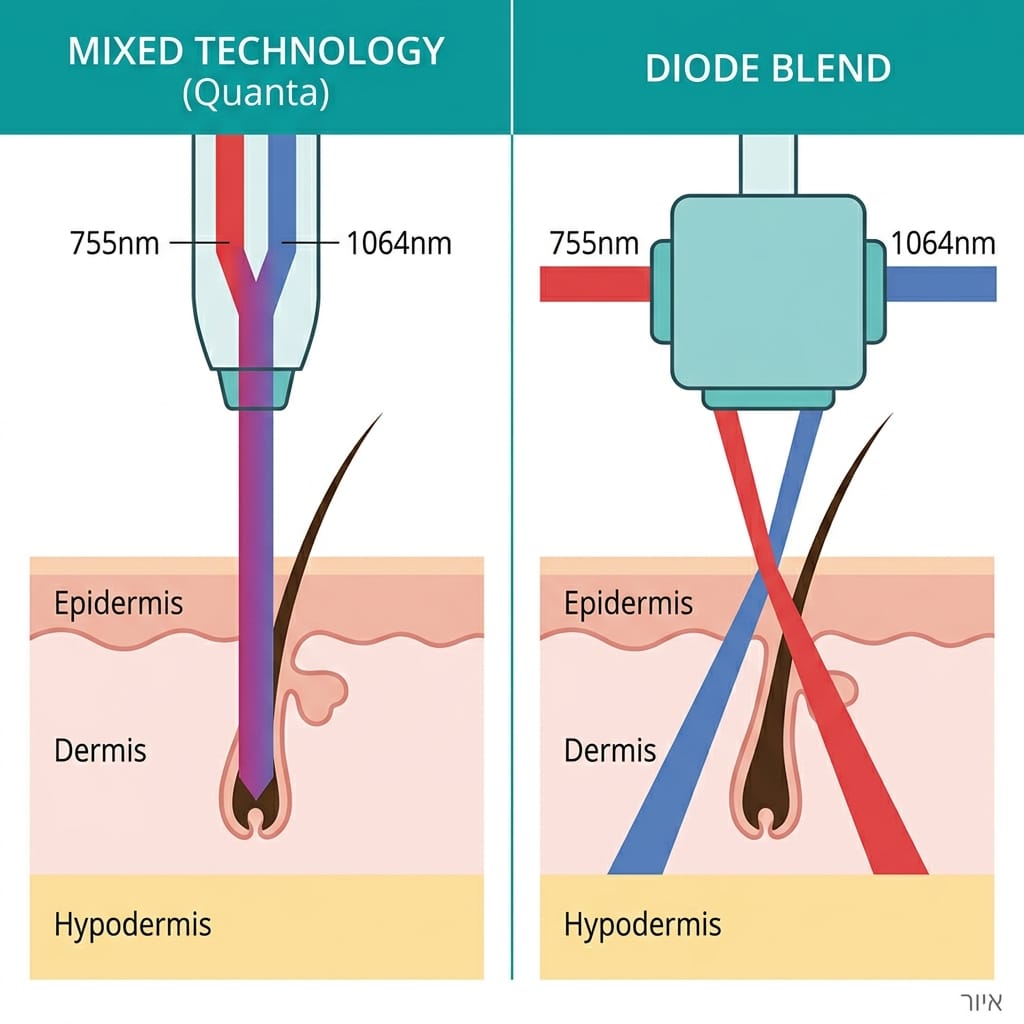
- The critical difference: in Quanta System’s mixed technology the two beams genuinely overlap on the same spot — unlike “mixed” diode devices, where the wavelengths sit side by side and do not truly overlap. In some cases the diode wavelengths do overlap to a degree, but not in a complete and perfect way.
- Lee Daniels distributes Quanta System’s Mixed Technology platforms — Thunder and Duetto MT — in Israel, with local, professional training and service.
What exactly is mixed technology?
A hair-removal laser works on the principle of selective photothermolysis: light energy is absorbed by the melanin in the hair follicle and converted into heat that destroys it. The problem is that a single wavelength always involves a compromise. You have to strike a balance between the temperature rise in the upper skin layer (the epidermis) and the temperature rise in the hair follicle. That balance effectively prevents us from working at excessively high fluences, because we risk causing burns in the effort to remove hair. The solution Quanta offers — mixed technology — has each wavelength act on a different part of the skin (Alexandrite is more focused on melanin, while YAG 1064nm is more focused on water and blood vessels), and together they manage to heat the hair follicle more than Alexandrite alone, while the epidermis stays at a lower temperature.
Alexandrite (755nm) is well absorbed by melanin and more effective on lighter skin, but less safe on dark skin. Nd:YAG (1064nm) penetrates deeper and is safe for dark skin, but less “aggressive” toward melanin.
Mixed technology resolves the compromise by delivering both wavelengths — in a single or combined emission. This way the system addresses both the melanin (the follicle target) and the hemoglobin (in the follicle’s blood supply) at the same time, which the cited source suggests can help achieve results in fewer treatments than a single-wavelength source.
Why does it matter for a clinic in Israel?
In Israel, the patient population is highly diverse in terms of skin tones — from Fitzpatrick I through VI — and many arrive for treatment with tanned skin for a significant part of the year. A single-wavelength system forces the clinic to turn certain patients away, to postpone treatments to particular seasons, or simply to offer “maintenance” treatments.
A mixed or hybrid technology platform removes the seasonal limitation and makes it possible to treat all skin types year-round. Fewer refusals, more patients, and a broader range of indications — hair removal, vascular lesions and skin resurfacing on the same system.
The critical difference: true overlap versus “mixed diode”
This is where the greatest confusion in the market lies. Many manufacturers market diode devices as “mixed technology” or “blend” — but the meaning is fundamentally different.
In “mixed” diode devices, the different wavelengths are emitted from sources that sit side by side in the handpiece — they cover adjacent areas on the skin but do not truly overlap on the same spot. And even when they do hit the same spot, because the lasers come from different sources there is an angle to the wavelength path, which means the hair follicle does not receive both lasers simultaneously. By contrast, in Quanta System’s mixed technology the two beams genuinely overlap on the same treatment spot, emitted simultaneously or sequentially through a single delivery. This is the difference between “two lasers acting on a similar area” and “two lasers acting together on the same follicle.”
| Aspect | Quanta Mixed Technology | “Mixed/blend” diode laser |
|---|---|---|
| Wavelength placement | Genuinely overlapping on the same spot | Side by side, adjacent spots |
| Energy combination | Both wavelengths on the same tissue volume | Spatial mixing, no true overlap |
| Wavelengths | Alexandrite 755nm + Nd:YAG 1064nm | Adjacent diode modules |
Dedicated optics were designed for this purpose too: a super-elliptical beam profile (almost square but without “spikes”), with an optimized Gaussian distribution (meaning energy is divided evenly), which minimizes over-overlap and distributes the energy uniformly. The optional OptiScan TH scanner delivers homogeneous energy across a wide area while minimizing unnecessary pulse overlap. It is worth emphasizing that the OptiScan TH is a strong, powerful scanner that makes it easy to cover large areas.
What does this mean for your clinic?
If you are considering purchasing a hair-removal device, the first question is not “how many wavelengths” but “do they truly overlap”. The Thunder platform by Quanta System is a Mixed Technology system that combines Alexandrite and Nd:YAG in overlapping beams, with an OptiScan TH scanner, and is designed for hair removal alongside a range of skin indications. Duetto MT is another mixed-technology platform from Quanta; it serves as an “entry-level” system into the field of hair removal.
Quanta System is an Italian laser manufacturer that has been operating since 1985 (over 40 years of experience). Lee Daniels, which has distributed Quanta’s devices in Israel since 2006 and supports more than 600 clinics, provides — alongside the device — clinical training, local service and maintenance, and professional guidance. The company is registered with AMAR and holds ISO 9001:2015 certification.
Frequently asked questions
What is mixed technology (Mixed Technology) in hair removal?
It is a laser technology that combines two wavelengths — usually Alexandrite 755nm and Nd:YAG 1064nm — in one system, in a single or combined emission. The combination allows effective, safe treatment across a wider range of skin types and hair types than a single-wavelength laser.
What is the difference between Thunder and a “mixed” diode laser?
In Quanta’s mixed technology the two beams genuinely overlap on the same treatment spot. In “mixed” diode devices the wavelengths are emitted from sources that sit side by side and do not truly overlap — so the combined effect on the same follicle is not the same.
Which skin types is mixed technology suitable for?
All skin types, including dark skin (Fitzpatrick VI) and tanned skin. The Nd:YAG wavelength is safer for dark skin, so the combination removes the seasonal limitation that exists with certain devices.
When was Quanta System founded?
Quanta System is an Italian laser manufacturer that has been operating since 1985 — over 40 years of experience in the field of medical and aesthetic lasers.
Source: How Mixed Technology is Enhancing Results in Laser Hair Removal — Aesthetic Medicine
By: the Lee Daniels team | Date: 12/07/2026
Want to hear more?
We would be glad to show physicians and clinics how the Thunder mixed-technology platform can expand your treatment offering — and to tailor a configuration to your clinic’s needs.
Lee Daniels — authorized distributor of medical aesthetic equipment in Israel