
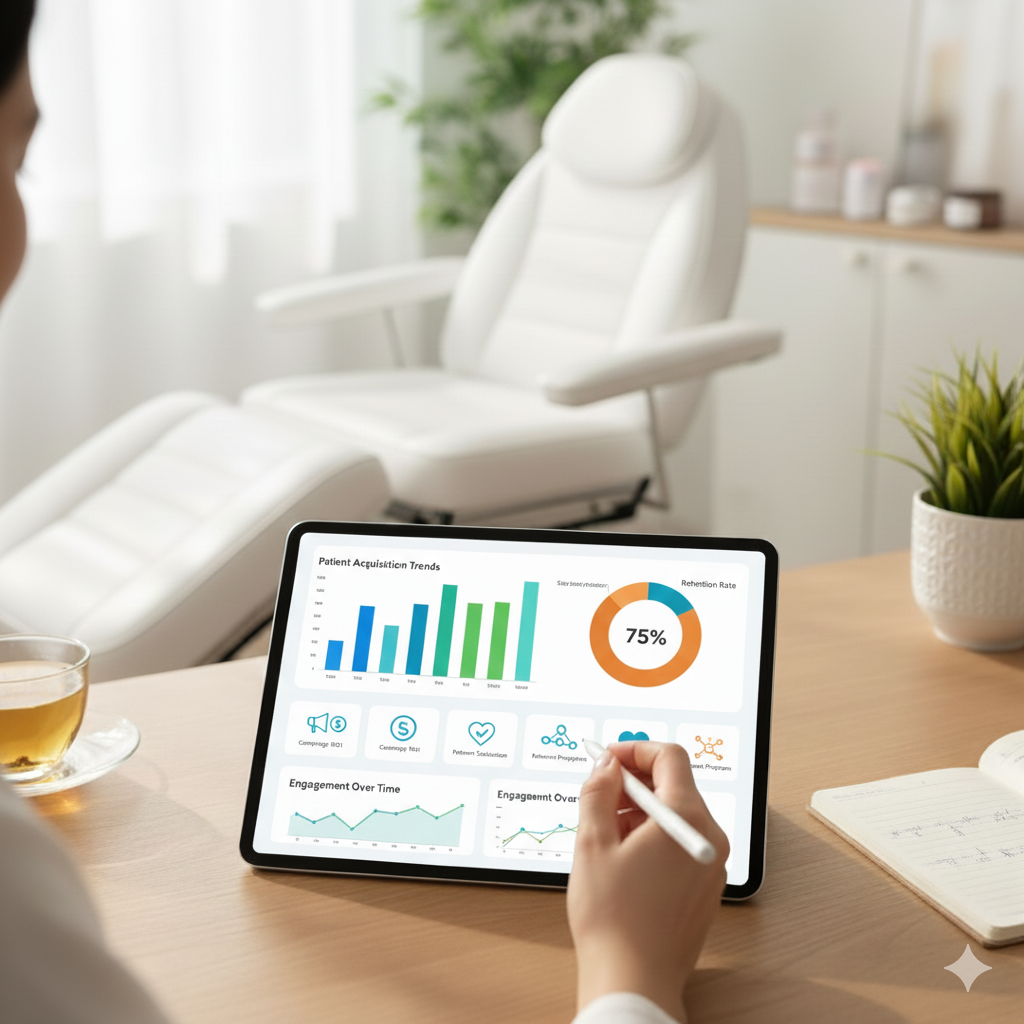
Key takeaways from the webinar. Presented by Croma Pharma, 19/11/2025
Here are the main points from the webinar:
Organic Content = Trust, Not Sales
Dr. Sophie put it this way:
Organic content is an essential stage, but it isn’t what closes appointments.
It builds familiarity, presence and a perception of professionalism,
and it lays the groundwork for converting patients later on.
When your content reflects the authentic, genuine identity of the clinic,
your audience responds better to paid campaigns.
⭐ So what can you do?
Post simple, consistent content that shows who you are:
your team, your process, patient satisfaction, and how you listen to patients.
The CRM Is Where Marketing Actually Happens
One of the strongest and most central points in the talk:
high conversions come from an audience that is already interested.
The CRM is the tool that gathers that audience,
lets you understand who they are and what they were interested in,
and lets you bring them back at the right time.
Dr. Sophie emphasized:
clinics that manage their CRM properly close several times more business.
⭐ So what can you do?
Build a clear patient journey:
an immediate response, a follow-up message, reminders, tracking and proactive re-engagement.
A path that surrounds the patient from the moment they reach out through to the procedure – with no one “falling through the cracks.”
Real Measurement: Not Clicks, but Results
Clicks, likes and comments can all be high and still bring in zero patients.
What truly matters – and what you need to measure, monitor and analyze:
• How many people left their details
• How many of them were followed up with
• How many booked an appointment, and how many actually showed up for it
• How many became patients
Only this reflects marketing that works.
⭐ So what can you do?
Define clear metrics for every campaign:
cost per lead, response rate, close rate, and customer acquisition cost.
Look at how customers actually behave.
“Where Did the Patient Come From?” Is a Must-Have Metric
Dr. Sophie said that the ability to understand where an inquiry originated
is what lets you improve campaigns and fine-tune budgets.
There is no more important insight than this:
if you don’t know where the patient came from,
you can’t know what’s working and what isn’t.
So what can you do?
Make sure every lead enters the CRM with an accurate source:
an ad, a story, organic, a referral, a form on the site, a specific campaign.
And from which specific ad or campaign.
And make sure the system pulls campaign sources correctly from the platforms.
We’ll add this: quite often you’ll want to ask the patient directly – what drew you to our advertising? Do you remember what you saw? What resonated with you there?
Persistence and Learning Over Time
You can’t judge a campaign by 24-48 hours.
The systems learn your audience, stabilize and improve over time.
Success comes when you build a system that measures over 30-60-90 days.
Not over a day, and not over a week.
⭐ So what can you do?
Give each campaign at least 10-14 days before making changes.
Don’t switch it off, don’t change it, don’t “break” it – let it learn.
Segmentation and Precision Make Every Campaign Sharp
Dr. Sophie presented clear data:
when you speak to every audience in the same language, conversion drops.
when you tailor messages by age, region and motivation, conversions rise.
⭐ So what can you do?
Build different ads for different audiences:
the 20-30 audience gets one message,
the 40-55 audience gets another.
Not one ad for everyone.
Experiment, Test and Keep Improving
Marketing doesn’t work on the first attempt.
It works on the fifth and the eighth attempt.
A/B testing is a condition for success – not an “add-on.”
Dr. Sophie stressed trying several content types in parallel:
image, video, slides, text – and measuring performance.
⭐ So what can you do?
Post 2-3 versions of the same message,
see which one brings the most serious inquiries –
and continue only with that one.
⭐ How Do You Retain Patients Over Time?
1) Track the patient’s path from the moment they reach out
Dr. Sophie emphasized that the way to understand why patients stay – or disappear –
is to analyze their journey:
where they came from → how long it took to respond → what was offered to them → what they experienced at the clinic.
Once you understand this path, it’s easy to spot weak points and strengthen them.
2) Fast Response = High Trust
One of the factors that most affects retention:
whether the clinic got back to the patient in time.
Someone who gets a quick reply feels their time is respected →
they come back, ask questions, and feel safe entering the process.
3) Continuous Communication – Not Only at the Sales Stage
Retention doesn’t begin after a treatment –
it begins after the very first inquiry.
The patients Dr. Sophie talks about stay for years,
because the clinic talks to them between treatments:
updates, recommendations, reminders, follow-up after a visit.
Consistent engagement = a sense of being cared for.
4) Understand What the Patient Needs – Not What We Want to Sell
Most clinics “push” a treatment.
But retention is built when you talk about what genuinely concerns the patient,
instead of what we want to sell.
A patient who feels understood – stays.
5) Metrics You Absolutely Must Track
To retain, you need to measure:
- How many customers come back?
- How often do they return?
- How long has it been since their last visit?
- Which treatment makes them return most often?
Retention is a number – not a gut feeling.
6) A Better Experience Beats Any Promotion
Dr. Sophie showed the data:
a customer who goes through a professional, clear and pleasant process –
stays several times longer than a customer who came in for a promotion.
Promotions bring traffic.
Service experience brings loyalty.
⭐ A Few More Practical Recommendations from Us to Lee Daniels Customers:
7) Build a Follow-Up Routine After Every Visit
The day after a treatment: ask how it went.
A week later: check the results.
A month later: remind them about a follow-up treatment.
Follow-up = gold for retention.
8) Give the Patient the Feeling That “Someone Remembers Me”
This can be:
- A physician who recalls what was done last time
- Addressing them by name
- A treatment recommendation tailored precisely to them
This kind of personalization creates enormous loyalty.
9) A Treatment Journey, Not a Single Treatment
A patient who doesn’t understand what comes next – won’t continue.
The path to retention:
give the patient a comprehensive, year-long treatment plan →
let them know the next step →
create a clear treatment sequence.
10) Transparency and Reliability Throughout
Patients stay where they feel safe.
Explaining treatments, costs, realistic results and expectations –
builds a foundation for years to come.
Patient retention doesn’t depend on promotions –
but on fast response, consistent support, a deep understanding of the need, an organized plan and an excellent experience.
If you’d like to sign up for our upcoming webinars on these and other topics, join our mailing list – click the link to register via WhatsApp:
https://wa.me/97236991900?text=updates
Lee Daniels Team
The Lee Daniels team | Israel’s leading distributor and marketer of medical aesthetics equipment, fillers and advanced laser systems. Authorized distributors of Croma Pharma, Quanta System, LEMI, Needle Concept and more. AMAR registration | ISO 9001:2015 | CE | FDA